
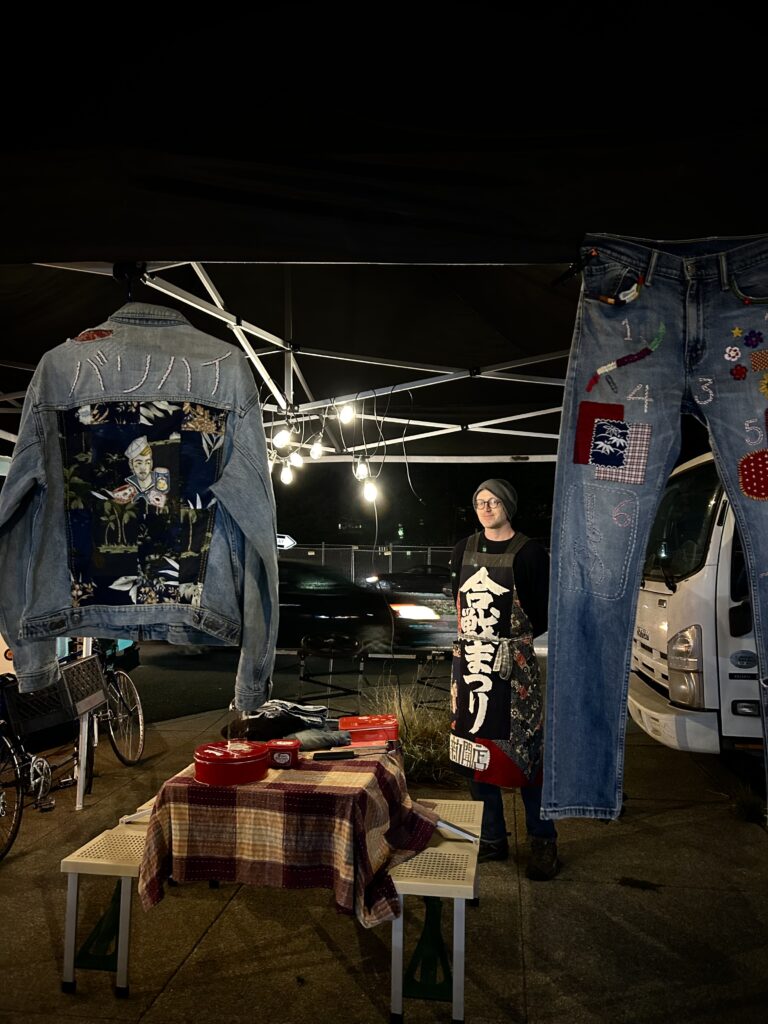
Whenever someone asks why I started this business, I have two easy answers. The first, because I like it. The second, it’s what I’m good at. Then, if they have the patience, I have some longer answers too.
Coming to the end of one full year in operation as a drop-off, pickup clothing repair service, it’s time to look back as well as forward. Not just why and how did this whole thing start, but how do I intend to keep it going?
Mending is not something I ever formally studied, it was just a personal pass-time, but I seemed to have some knack for it. So when covid struck and I was laid off from both my previous jobs (journalist, bike messenger) I used the government stimulus as an opportunity to take a breather and seriously consider what line of work to go into next, and not just throw myself at the next available paycheck.
I knew I wanted to work more for myself, and that it ought to be in a field where I was uniquely qualified. I also knew that there are thousands – probably even tens of thousands – of people just in the Bay Area who want to open a cafe or a bar or a record store or bookshop, but I didn’t know anyone else who fixed clothes. And in those days of shelter-in-place, I was knitting sock after sock and patching up all my worn-out jeans. So once venues began to open again, this quirk of fashion gained me a mild form of local celebrity, one which I had never quite attained in either of my previous lines of work. No one ever recognized me in the street when I was a journalist or a bike messenger – or at least, not in a good way – but I got some notice as the local mender. It’s not that I craved fame, but what I did crave was a clear sense of purpose. That I was appreciated by those in my community, and my work brought value to their lives.
Friends asked me to fix their clothes. Then the friends of friends. And so on. The business grew piecemeal, organically. Which is much in the way I approach the repairs, and frankly, my life. Considering the virtues and limitations of the presently available resource, and then beginning the work. The plan only comes in retrospect.
Then, when the world began to open again, the manager of the local farmers market approached and asked if I would consider opening a mending booth. After all, there was a knife sharpener who maintained kitchen knives and garden tools, so having someone who repaired clothing didn’t seem such a stretch, and very much in line with the market mission of reducing overall waste.
The manager’s initial idea was that I would mend customers clothes while they shopped. But as a business strategy, “repairs while you wait” quickly fell to the wayside given the diversity of customer needs. It was impossible to match every kind of garment and textile with the limited market setup.
Ah. That setup.
Because I didn’t have a car, and wasn’t about to get one, I bought a used tandem bicycle for $350, took off the rear seat and replaced it with a set of overlarge baskets, balanced one to each side, and this rig – along with a trailer I’d knocked together with about $60 of scrap purchased from a junk yard– became the transport to and from market, carrying a table ($20 off Craigslist), a canopy ($50, also Craigslist), and sewing supplies, with space enough to bear away customer projects.
And so the farmers market drop off / pickup clothing repair service was born. Of course it still needed a name, one that summarized the general ‘can do’ spirit of dusting yourself off and get on with life. But for that you’ll have to read another entry.
There was also the matter of insurance, as all market vendors required some form of protection to legally operate – I found a quite decent one for $25 a month – and there was a one time market membership fee of $100. Altogether my startup costs were $605 for the first month. Significantly less expensive than paying rent on a physical storefront and a figure I quickly made back.
That first month was a wash, but at least I wasn’t in the hole, as most of those fees were one-time costs. And for the next several months I made between $600 and $800 a month just on mending clothes, a quite tidy figure to add to my other, weekend job, working for a pop-up restaurant. (Mending has never been enough by itself)
Customers began to seek me out. I gained further notoriety.
“The traveling tailor!” on customer called me.
“The artful mender!” said another.
Both became part of my brand.
As the months passed my craft improved, and as I became more conscious of the time it took to perform a mend, I realized I had been critically undervaluing my skillset. In August I raised nearly all my rates – from $5 to $10 for a darn, from $15 to $25 for replacing a zipper, from $10 to $20 for hemming a pair of pants – still significantly lower than a professional tailor (I don’t pay rent on a shop, I don’t have employees to pay, I’m not paying back a student loan for having gone to fashion school) but I think the increase may have scared off some earlier patrons.
Then the seasons changed and sales slumped to below subsistance level. By October no one seemed to want to be at the market in the dark. For the past few months I’ve made very little from mending at all. The first two weeks of December, working four markets, I made $100 total, of which $40 went to weekly stall fees, so only $60 in take home pay for 17 hours of market, or an hourly average of $3.53 in profit per market. Now I did have some last minute deliverance in the form of commissions – pants for one customer ($150) a shirt for another ($250) – which significantly raised December’s income, or at least raised it to a level where I wasn’t in the hole. But neither of those customers found me via the market, and $3.53 / hour net was not enough to keep me around.
Of course a year ago I might have rejoiced at that figure – income from my craft! – but now I know better. Still, I have to give the market manager credit for the initial encouragement. They had said they thought there was a large base of customers who would want my service, and they were absolutely right. But I’ve reached the limit of what the market can offer, both in terms of income and lessons, and now it’s time to develop the business in other ways.
Which is to say I’m leaving.
Oh I’ll still be fixing clothes, but I won’t be operating at the Berkeley farmers markets any more.
What ways will the business develop? I don’t quite know just yet. I’ve been teaching classes on mending, which has been quite rewarding, not to mention lucrative as I make between $150 and $250 per two hour class. And as my skills have improved, I’ve been able to request higher rates for my services. Also I’ve been recruiting more customers via this website and Instagram so I don’t have to setup at weekday markets.
I hope this year to start designing more clothes, and to take more classes myself for my own professional development, and to make enough money per month that I can afford leave my other job. It’s been a lot of fun on the weekends to help two restaurateurs operate and grow their own business – Sonder Cafe – but that’s my energy and my attention going to someone else’s dream. This dream is mine.
What all this means together is still a mystery. I don’t believe much in the notion of forging on in spite of circumstance. I believe more in patience and purpose, in observation and meditation. The present is the resource, not the obstacle.
I’m grateful for my time. One path is ended. What wondrous new path is next?